



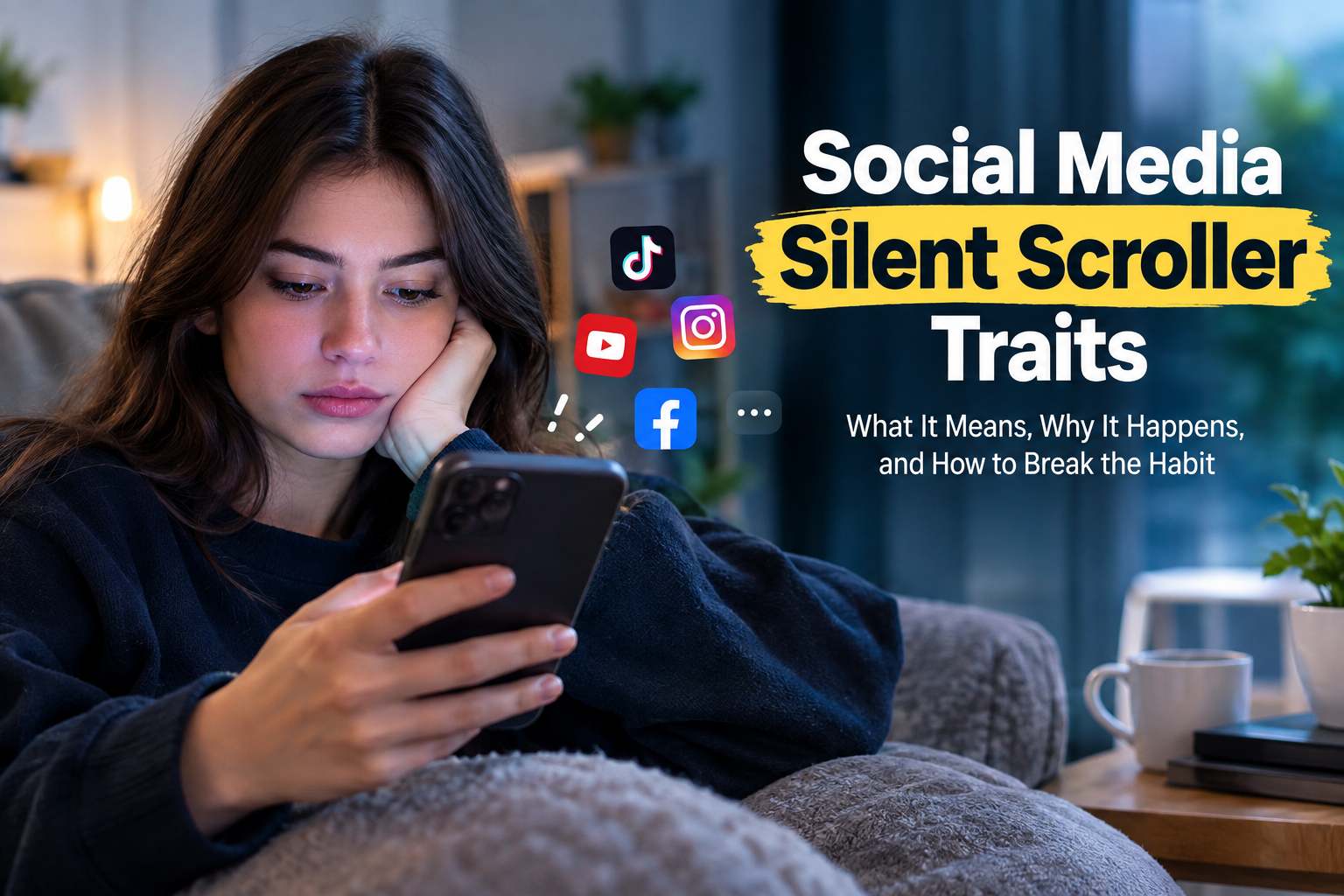
If you regularly watch Instagram Reels, TikToks, Facebook posts, or other social content without liking, commenting, or posting anything yourself, you may be a social media silent scroller.
Silent scrolling is common. It does not automatically mean someone is shy, antisocial, lonely, or unhappy. In many cases, people simply prefer consuming content without becoming part of the conversation.
Researchers often describe this behavior as passive social media use—viewing feeds, profiles, photos, videos, or comments without directly interacting with other users. Research also suggests that the effects of passive use vary considerably from person to person, so it is better to look at the behavior in context rather than treat it as a personality diagnosis.
What Is a Social Media Silent Scroller?
A social media silent scroller is someone who spends time consuming social media content while rarely leaving visible signs of participation.
For example, they might:
- Watch dozens of short videos without liking them
- Read comments without replying
- Look through friends’ profiles without interacting
- Follow accounts but rarely post themselves
- Read discussions without joining them
- Save interesting content instead of commenting
- Know what is happening online without publicly participating
The key characteristic is observation rather than visible interaction.
This behavior is sometimes called lurking or passive social media use. However, “silent scroller” is a casual description rather than a recognized psychological personality type.
Common Social Media Silent Scroller Traits
1. They Prefer Observing Over Participating
One of the most obvious traits is a preference for watching rather than joining the conversation.
A silent scroller may be genuinely interested in a topic but have no desire to comment. They can spend considerable time reading discussions, watching videos, and checking updates while remaining almost invisible to other users.
This does not necessarily indicate a lack of interest. Sometimes observation is simply their preferred way of using social media.
2. They Rarely Post Personal Updates
Silent scrollers often have very little public content compared with the amount of content they consume.
They may have an account that has existed for years but only a handful of posts. They might still use the platform every day, but most of their activity happens privately through viewing, searching, messaging, or saving content.
There can also be a practical reason for this. Social media involves an audience, and people may think carefully about how they present themselves online. Research on online communication suggests that multiple audiences and feedback can encourage people to manage how they present themselves.
3. They Think Before They Comment
Some silent scrollers are not uninterested—they are simply selective.
Before posting a comment, they may ask themselves:
- Is this worth saying?
- Will someone misunderstand me?
- Do I actually have something useful to add?
- Do I want strangers to see my opinion?
- Is this discussion likely to become an argument?
As a result, they may read an entire conversation without contributing a single word.
4. They May Value Privacy
Privacy can be another reason someone remains quiet online.
Some people do not want their opinions, relationships, interests, or daily activities permanently visible to other users. They may prefer consuming information without creating a detailed public record of their own behavior.
Research on lurking has also examined connections between privacy concerns, perceived privacy risks, lurking, and self-concealment.
That does not mean every silent scroller is highly private. It simply shows that privacy can be one factor behind limited public participation.
5. They Can Be Highly Aware of Online Trends
Being quiet does not mean being disconnected.
A person who never posts may still know about:
- Viral TikTok trends
- Celebrity news
- Memes
- Sports discussions
- Political debates
- New products
- Internet drama
- Popular creators
In fact, a silent user can sometimes know more about online conversations than a highly active poster because they spend their time observing different communities.
6. They Often Consume Content for Entertainment
Sometimes there is nothing complicated behind the behavior.
People open social media because they want something entertaining to watch after work, during a break, or before going to sleep.
They may not want conversation at all. They simply want videos, photos, news, recipes, sports clips, or other content.
This is an important distinction because silent scrolling itself is not automatically a problem.
Read More: Social Media Stuff EmbedTree: What It Is and How It Works
7. They May Avoid Online Arguments
Comment sections can become exhausting.
A person who dislikes confrontation may decide that reading an argument is preferable to becoming involved in it. They might understand both sides of a debate but choose not to respond.
This can be especially appealing on platforms where conversations move quickly and comments can attract criticism from strangers.
8. They May Be Careful About Their Digital Footprint
Some users think about the fact that online activity can be visible to friends, coworkers, family members, employers, or strangers.
Instead of frequently posting opinions, they choose to consume content quietly.
This can be particularly relevant when someone uses social media for both personal and professional purposes. Keeping a lower public profile may simply feel safer or more convenient.
Why Do People Become Silent Scrollers?
There is no single explanation.
Two people can behave exactly the same way online for completely different reasons.
One person might be naturally private. Another might be busy. Someone else might be socially confident but simply uninterested in commenting.
Possible reasons include:
- Entertainment
- Curiosity
- Habit
- Privacy concerns
- Fear of judgment
- Lack of time
- Avoiding arguments
- Social anxiety
- Information gathering
- Preference for one-way content consumption
- Not wanting to create public posts
- Feeling that commenting adds little value
Because of these differences, it would be misleading to say that silent scrolling reveals a specific personality type.
Is Silent Scrolling a Sign of Introversion?
Not necessarily.
An introverted person may prefer observing rather than participating, but an extroverted person can also be a silent scroller.
Social media behavior depends on the platform, the content, the audience, and the individual’s reason for using the app.
Someone might be extremely social in person but almost completely silent online. Another person might post constantly online but be quiet in face-to-face situations.
So silent scrolling should not be used as a reliable test of introversion or extroversion.
Is Silent Scrolling Bad for You?
Not automatically.
Research on passive and active social media use has produced mixed results. A 2024 meta-analysis covering 141 studies found that many relationships between active or passive social media use and well-being were small or negligible, although some associations varied depending on context.
Other research has found that passive consumption can sometimes be associated with worse emotional outcomes, potentially through experiences such as social comparison or envy. But researchers have also emphasized that passive use is not universally harmful.
The more useful question is therefore not simply “Do I silently scroll?” but “How does my scrolling affect my life?”
If you can use social media for entertainment and then move on with your day, there may be little reason for concern.
If scrolling regularly leaves you feeling worse, interferes with sleep, replaces important activities, or becomes difficult to control, it may be worth changing your habits.
Silent Scrolling vs. Active Social Media Use
The difference is straightforward.
| Silent Scrolling | Active Use |
| Watching videos | Creating videos |
| Reading posts | Writing posts |
| Browsing profiles | Updating your profile |
| Reading comments | Posting comments |
| Looking at photos | Uploading photos |
| Watching discussions | Participating in discussions |
| Saving content | Sharing content |
However, the distinction is not always perfect.
For example, someone might spend 20 minutes silently watching videos and then send one private message to a friend. Another person might publicly comment on posts but never create original content.
Researchers increasingly argue that the active-versus-passive distinction is more complicated than it first appears.
When Silent Scrolling Becomes a Problem
Silent scrolling deserves more attention when the behavior starts interfering with everyday life.
Potential warning signs include:
- Opening social media automatically every few minutes
- Losing track of time repeatedly
- Staying up late because you keep scrolling
- Feeling worse after comparing yourself with others
- Avoiding responsibilities to continue scrolling
- Becoming frustrated when you cannot access social media
- Spending long periods consuming content without enjoying it
- Reaching for your phone whenever you feel bored or uncomfortable
The amount of time alone does not tell the whole story. The purpose of use and the user’s experience matter too.
Research reviews have found that social media effects can differ substantially depending on the type of activity, the person, and the context.
How to Stop Being a Constant Silent Scroller
You do not necessarily need to delete every social media app.
Instead, try making your use more intentional.
Set a Specific Reason for Opening an App
Before opening TikTok, Instagram, Facebook, or another platform, ask yourself what you want to do.
If you have no particular reason, consider doing something else for a few minutes.
Turn Off Unnecessary Notifications
Notifications can repeatedly pull your attention back to social media.
Keeping only genuinely useful notifications can reduce unnecessary interruptions.
Create Phone-Free Periods
Try keeping your phone away during meals, work sessions, conversations, or the last part of your evening.
Small boundaries are often easier to maintain than attempting to quit everything immediately.
Follow Better Content
Your feed influences what you see repeatedly.
Unfollow or mute accounts that consistently make you feel stressed, angry, inadequate, or distracted. Replace them with content that is genuinely useful or enjoyable.
Do Something Active Offline
If scrolling is mainly filling boredom, replace some of that time with another activity—walking, exercising, reading, cooking, talking with friends, or working on a personal project.
The goal is not to eliminate every minute of passive entertainment. It is to make sure social media is not automatically consuming every spare moment.
Read More: Cell Without Senzu vs Gohan: Who Would Win?
The Bottom Line
Social media silent scroller traits are better understood as behaviors than personality characteristics. Someone who rarely likes, comments, or posts may be private, cautious, busy, entertained, curious, or simply uninterested in public interaction.
Silent scrolling is not automatically unhealthy, either. Research shows that the relationship between passive social media use and well-being is complicated, with outcomes differing according to the person, content, context, and type of use.
The most useful test is simple: if scrolling fits comfortably into your life, it may just be your preferred way of using social media. If it consistently takes control of your time or affects how you feel, your habits may be worth changing.
FAQs
What is a silent scroller on social media?
A silent scroller is someone who regularly consumes social media content but rarely likes, comments, shares, or publishes posts. The behavior is commonly related to what researchers call passive social media use.
Are silent scrollers introverts?
Not necessarily. Silent scrolling can occur among both introverted and extroverted people. Privacy, convenience, entertainment, habit, and avoiding online conflict can all influence the behavior.
Why do people scroll but never like anything?
People may prefer observing, want to protect their privacy, avoid attention, feel uncomfortable commenting, or simply find scrolling more entertaining than interacting.
Is passive social media use unhealthy?
Not automatically. Research findings are mixed. Some studies associate passive use with poorer emotional outcomes, while broader reviews show that effects vary depending on the individual and context.
How can I reduce silent scrolling?
Start by identifying why you open social media, reducing unnecessary notifications, creating phone-free periods, improving your feed, and replacing some scrolling time with offline activities.
