




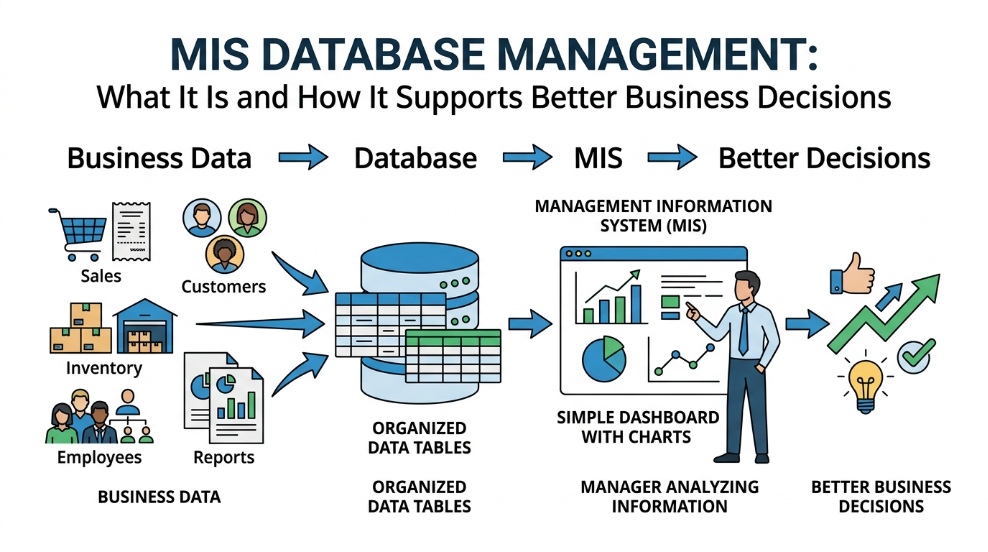
MIS database management is the process of collecting, organizing, storing, maintaining, and using business data within a management information system. Its purpose is to make reliable information available to managers and teams so they can monitor operations, identify problems, and make better decisions.
A management information system, commonly called MIS, combines people, processes, technology, and data. The database is a central part of that system because it stores the information that reports, dashboards, and business applications rely on.
What Is MIS Database Management?
MIS database management connects business data with management needs. A company may collect information about sales, customers, inventory, employees, suppliers, expenses, projects, or equipment. Database management helps keep that information structured and accessible.
Instead of keeping important records across disconnected spreadsheets and files, an MIS can organize data so authorized users can retrieve consistent information when they need it.
MIS can refer to an organizational function as well as information systems used to store, organize, analyze, and report business information.
Why Databases Matter in an MIS
A management information system is only as useful as the data behind it. Poorly maintained data can lead to incorrect reports and weak decisions.
A well-managed database helps a business:
• Keep records in a consistent format
• Reduce unnecessary duplication
• Find information faster
• Produce recurring management reports
• Compare performance across periods
• Control who can access sensitive information
• Support dashboards and analytics
• Maintain a clearer historical record
The goal is not simply to collect more data. The goal is to maintain useful data that can support real business questions.
Core Components of MIS Database Management
Data Collection
Data can come from sales systems, websites, accounting tools, customer relationship management platforms, inventory systems, employee records, forms, sensors, and other operational sources.
The collection process should capture the information the business actually needs. Collecting large amounts of irrelevant data creates more storage and governance work without necessarily improving decisions.
Database Structure
A database needs a logical structure. Records should use consistent fields, formats, identifiers, and relationships.
For example, a customer database may contain a customer ID, name, contact information, account status, order history, and other relevant fields. A unique ID helps the system distinguish one customer from another even when two people share the same name.
Data Storage
Businesses may store databases on local infrastructure, cloud platforms, or a combination of both. The appropriate choice depends on cost, security, performance, compliance, availability, and integration requirements.
Data Processing
Raw data often needs to be cleaned, validated, combined, calculated, or categorized before it becomes useful management information.
A sales transaction by itself is operational data. A monthly report showing revenue by product, region, salesperson, and margin turns many transactions into information that managers can interpret.
Reporting and Analysis
Reports and dashboards are among the most visible outputs of an MIS. They can show sales performance, stock levels, customer activity, project status, costs, productivity, or other key indicators.
Good reporting focuses attention on information that supports a decision rather than filling a screen with every available metric.
Database Management System vs MIS
A database management system, or DBMS, is software used to create, store, retrieve, update, and manage data in databases. An MIS is broader.
The distinction can be summarized simply:
• DBMS focuses on managing data.
• MIS focuses on using information to support organizational management and decisions.
• A DBMS can be one technical component inside an MIS.
• MIS also involves people, procedures, reporting, business rules, and management objectives.
Examples of MIS Database Management in Business
Sales Management
A sales MIS can combine orders, revenue, customer records, sales representatives, territories, and product data. Managers can use the resulting reports to compare performance and identify changes in demand.
Inventory Management
Inventory databases track products, quantities, locations, receipts, sales, and stock movement. MIS reporting can help teams identify low stock, slow-moving products, reorder needs, or unusual inventory patterns.
Customer Management
Customer data can support service history, purchase behavior, account status, and communication records. A well-designed system gives authorized teams a more consistent view of the customer.
Financial Management
Financial information systems may organize income, expenses, budgets, invoices, payments, and other records. Managers can compare actual performance with targets and investigate major variances.
Human Resources
HR information systems can store employee records, attendance, roles, compensation data, training records, and performance information. Access controls are particularly important because much of this data is sensitive.
Benefits of Effective MIS Database Management
Better Decision Support
Managers can make stronger decisions when they have timely, relevant, and accurate information.
Improved Efficiency
Centralized and structured information reduces time spent searching through disconnected files or manually rebuilding recurring reports.
Greater Data Consistency
Defined fields, validation rules, and controlled processes can reduce inconsistent records and repeated data entry.
Faster Reporting
When operational data flows into a managed system, recurring reports can often be generated more efficiently than manual spreadsheet-based reporting.
Improved Accountability
Historical records and audit trails can help organizations understand when information changed and who performed specific actions, depending on the system.
Common MIS Database Management Challenges
Data Quality Problems
Duplicate records, missing fields, inconsistent formats, and outdated information can reduce trust in reports.
Security Risks
Business databases may contain customer, employee, financial, or operational information. Organizations need appropriate authentication, authorization, encryption, backups, monitoring, and security procedures.
Disconnected Systems
When departments use separate applications that do not integrate properly, the organization can end up with several versions of the same information.
Poor Database Design
A database that was created without clear relationships, identifiers, and business rules can become difficult to maintain as data volume grows.
Too Many Reports
More reports do not automatically mean better management. Reports should answer useful questions and connect to decisions or actions.
MIS Database Management Checklist
Use this checklist when reviewing an MIS database:
• Define what business decisions the data should support.
• Identify authoritative data sources.
• Use consistent naming and data formats.
• Create unique identifiers where needed.
• Remove or merge duplicate records carefully.
• Validate important fields.
• Define user roles and access permissions.
• Back up critical information.
• Document important database rules.
• Review data quality regularly.
• Archive or remove obsolete information according to policy.
• Test reports against source data.
• Review integrations after system changes.
• Track important security and access events.
How to Improve an Existing MIS Database
Start With Business Questions
Before changing technology, identify what managers need to know. Examples include which products are most profitable, which locations are underperforming, or which customers have stopped purchasing.
Audit the Current Data
Look for duplicates, missing values, inconsistent naming, obsolete records, and fields that no one uses.
Define a Single Source of Truth
Decide which system owns each important type of data. This reduces conflicts when different applications contain different values for the same record.
Automate Carefully
Automation can reduce manual work, but automated bad data is still bad data. Validate inputs and test integrations before relying on automated reports.
Review Access
Users should have the access required for their work, but sensitive data should not be available more broadly than necessary.
Frequently Asked Questions
What does MIS stand for?
MIS stands for Management Information Systems or Management Information System, depending on the context. It generally refers to systems and organizational practices used to provide useful information for management and business decisions.
What is a database in MIS?
A database in MIS is an organized collection of data used by the information system. It may contain customer, sales, inventory, employee, financial, or operational records.
What is the role of DBMS in MIS?
A DBMS provides tools for storing, retrieving, updating, securing, and managing database information. It can serve as the database layer within a broader MIS.
What is the main purpose of MIS database management?
The main purpose is to keep business data accurate, organized, accessible, and useful so it can support reporting, operations, planning, and management decisions.
Final Thoughts
MIS database management turns business records into a structured information resource. The technology matters, but successful management also depends on clear business rules, data quality, security, ownership, and reporting discipline.
A strong MIS does not simply store information. It helps the right people access reliable information at the right time and use it to understand what is happening in the business.
