



A Google Shopping Ads agency helps ecommerce businesses advertise products across Google using product feed data, campaign structure, bidding, audience signals, conversion tracking, and ongoing optimization. The best agency does more than launch ads. It connects Merchant Center, product data, Google Ads, analytics, and profitability targets into one system.
If your store has hundreds or thousands of products, this specialist support can be valuable. Shopping campaigns depend heavily on feed quality and accurate conversion data, so weak product titles, incorrect attributes, disapprovals, or poor tracking can limit performance before bidding strategy even becomes the main issue.
What Does a Google Shopping Ads Agency Do?
A Google Shopping Ads agency manages the technical and advertising work required to promote ecommerce products through Google. Depending on the account, this may include Standard Shopping campaigns, Performance Max campaigns with product feeds, Merchant Center management, conversion tracking, remarketing, and feed optimization.
The agency should understand both advertising and ecommerce economics. More clicks are not automatically better. The real goal is usually profitable revenue, stronger return on ad spend, new customer acquisition, or growth within an acceptable cost of sale.
Core Google Shopping Ads Services
Google Merchant Center Setup and Management
Merchant Center is the product data layer behind Shopping ads. An agency should be able to configure the account, connect the store, review diagnostics, resolve eligible product issues, and monitor policy or data problems.
Product Feed Optimization
Product feed quality can strongly influence how Google understands and matches products. A good Google Shopping Ads agency reviews titles, descriptions, product types, Google product categories, brands, GTINs, availability, pricing, images, and other relevant attributes.
Titles should describe products clearly and include useful attributes without becoming unreadable keyword strings. Feed optimization should reflect the products and search intent rather than simply repeating keywords.
Campaign Structure
Campaign structure determines how products, budgets, priorities, bidding, and reporting are organized. A store may benefit from separating products by category, margin, best sellers, price, seasonality, inventory level, or business priority.
There is no universal structure that works for every ecommerce store. A competent agency should be able to explain why it has grouped products in a particular way.
Conversion Tracking and Revenue Measurement
Accurate conversion tracking is essential. The agency should verify purchase tracking, transaction values, currency, attribution setup, and duplicate conversion risks. Enhanced conversions and analytics integrations may also be appropriate depending on the store and consent setup.
If revenue data is inaccurate, automated bidding can optimize toward the wrong signals.
Bidding and Budget Management
Shopping campaigns can use different bidding approaches depending on campaign type, account maturity, data volume, and business objectives. An agency should not choose a target ROAS simply because a high percentage looks attractive.
An overly restrictive ROAS target can reduce traffic and eligible auction participation. A target that is too loose can increase volume while sacrificing profitability. The correct level should be based on margins, historical performance, growth goals, and conversion data.
What Makes a Good Google Shopping Ads Agency?
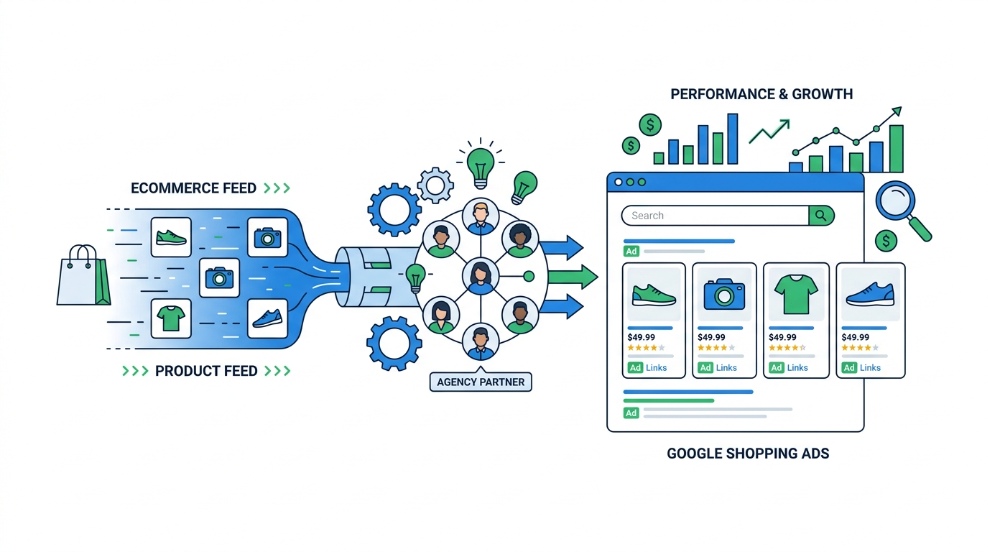
A strong agency should be able to work across the full ecommerce advertising stack rather than focusing only on campaign settings.
Use this checklist when evaluating a provider:
• Experience with ecommerce and Shopping campaigns
• Strong Google Merchant Center knowledge
• Product feed optimization capability
• Reliable purchase and revenue tracking
• Clear reporting on revenue, ROAS, cost, conversions, and trends
• Understanding of Standard Shopping and Performance Max
• Ability to diagnose product disapprovals and feed errors
• Knowledge of seasonality, promotions, inventory, and pricing
• Transparent communication about tests and account changes
• Focus on profitable growth rather than vanity metrics
Google Shopping Agency vs General PPC Agency
A general PPC agency may be excellent at Search campaigns but have limited product-feed experience. Shopping requires a different set of skills because product data plays a central role in ad eligibility and matching.
A specialist should understand Merchant Center diagnostics, ecommerce tracking, feed rules, product segmentation, shopping search terms, product-level performance, and retail bidding economics.
For ecommerce businesses where Shopping represents a major share of paid revenue, this specialization can matter.
Standard Shopping vs Performance Max
Standard Shopping gives advertisers more traditional campaign-level control and Shopping-specific reporting. Performance Max can distribute ads across multiple Google inventory sources and uses automation more extensively.
Neither campaign type should be treated as automatically superior in every account. The right approach depends on available data, business objectives, creative assets, product range, account history, and the level of control required.
An experienced Google Shopping Ads agency should be able to explain when it prefers Standard Shopping, Performance Max, or a carefully planned combination.
How to Evaluate Agency Performance
Do not judge performance from clicks and impressions alone. Ecommerce advertising should be connected to commercial outcomes.
Important metrics may include:
• Conversion value
• Return on ad spend
• Cost per purchase
• Conversion rate
• Average order value
• New customer acquisition cost
• Product-level profitability
• Search impression share where relevant
• Merchant Center product eligibility
• Revenue and margin contribution
ROAS also needs context. A 500 percent ROAS may be excellent for one store and unprofitable for another because product margins, shipping costs, returns, overhead, and customer lifetime value differ.
Questions to Ask Before Hiring a Google Shopping Ads Agency
How Will You Optimize My Product Feed?
Ask for a clear explanation. The answer should cover product attributes, titles, categorization, identifiers, diagnostics, and ongoing feed monitoring rather than vague claims about adding keywords.
How Do You Measure Purchases and Revenue?
The agency should explain how it validates conversion actions and transaction values. Tracking should be tested before major bidding decisions rely on it.
How Often Will You Optimize the Account?
Optimization frequency depends on spend and data volume. What matters is whether the agency has a repeatable process for reviewing search demand, products, budgets, bidding, diagnostics, tracking, and business changes.
Will I Own My Google Ads and Merchant Center Accounts?
Businesses should generally maintain appropriate access to their advertising and Merchant Center assets. Clarify ownership and access before work begins.
How Do You Handle Low-Performing Products?
A useful answer should go beyond pausing everything with poor ROAS. Some products may need feed improvements, different segmentation, price review, better landing pages, more data, or different bidding treatment.
Common Google Shopping Mistakes an Agency Should Prevent
Poor Product Titles
Generic titles can make it harder for Google and shoppers to understand the exact product. Titles should contain meaningful product information in a natural format.
Incorrect Conversion Values
If purchase values are duplicated or incorrect, campaign reports can look profitable while the underlying data is wrong.
Ignoring Merchant Center Diagnostics
Disapproved or limited products cannot contribute fully to campaign growth. Diagnostics should be monitored regularly.
Setting an Unrealistic Target ROAS
A very high target can restrict delivery when the account cannot consistently achieve it. Targets should be informed by actual performance and profitability.
Treating Every Product the Same
Products have different margins, conversion rates, demand, seasonality, prices, and inventory levels. Product-level analysis is essential for larger catalogs.
When Should You Hire a Google Shopping Ads Agency?
Specialist management may make sense when your store already generates sales but Shopping performance has stalled, Merchant Center has persistent issues, your feed is large or complex, tracking is unreliable, or your internal team lacks time for continuous optimization.
It can also help when you are scaling into new product categories or markets and need stronger control over feed structure and measurement.
A small store with only a few products and limited advertising budget may not need a full-service agency immediately. In that case, a one-time setup, audit, or consulting engagement may be more economical.
Frequently Asked Questions
What is a Google Shopping Ads agency?
A Google Shopping Ads agency is a PPC or ecommerce advertising provider that specializes in product-based Google Ads campaigns, Merchant Center, product feeds, conversion tracking, bidding, and optimization.
Can an agency guarantee a specific ROAS?
No responsible agency can guarantee a fixed future ROAS because auction competition, pricing, demand, website conversion rate, inventory, margins, seasonality, and other factors change. Agencies can set targets and optimize toward them, but outcomes are not fully controllable.
Does Google Shopping use keywords?
Shopping campaigns rely heavily on product feed information and Google’s understanding of user queries rather than traditional positive keyword targeting used in Search campaigns. Search themes and other signals may apply in certain campaign types, while negative keywords and account controls can also be relevant.
How long does Google Shopping optimization take?
Some feed or tracking fixes can have an immediate operational effect, but reliable performance evaluation normally requires enough conversion and auction data. The appropriate testing period depends on traffic, budget, conversion volume, product range, and seasonality.
Is Performance Max the same as Google Shopping?
No. Performance Max is a campaign type that can use a Merchant Center product feed and serve product ads, but it can also reach other Google inventory. Standard Shopping is a separate campaign type focused on Shopping inventory and related placements.
Final Thoughts
Choosing a Google Shopping Ads agency should come down to expertise, transparency, measurement, and business fit. Look for a team that understands Merchant Center and product feeds as deeply as campaign bidding.
The strongest partner should be able to explain what it is changing, why the change matters, how success will be measured, and how advertising performance connects to your store’s actual profitability. That approach is more useful than chasing clicks, impressions, or an arbitrary ROAS number without context.
