



Searching.Application Mobile Dual Media Can be confusing because the phrase doesn’t refer to a simple consumer app. In many cases, it refers to DualMedia, a Paris-based digital agency that builds custom mobile applications for businesses. The company also provides web development and SEO services.
There’s another reason the keyword is confusing: Some websites use “dual media” as a general description for mobile experiences that combine different types of content, such as video, audio, images, text, and interactive features.
If you’re researching DualMedia as a potential development partner, the first step is important. This guide explains what the company offers, how a typical mobile development project works, what technologies might be involved, what affects the price, and what businesses should consider before embarking on a project.
What is Application Mobile Dual Media?
Application Mobile Dual Media Mainly refers to DualMedia’s mobile application development services.
The company presents itself as a digital agency based in Paris and says it has been operating since 2000. Its services include web development and search engine optimization, as well as mobile application development for iPhone, iPad, and Android.
The important point is that there is DualMedia.There is no downloadable “DualMedia app” .This is an agency that works with organizations that want to design and create their own digital products.
This distinction makes a difference if you come across this phrase while searching for an app to download. You should first determine whether you are looking for a specific application or researching an agency’s development services.
What types of mobile apps does DualMedia develop?
A custom mobile application can serve very different purposes depending on the business behind it.
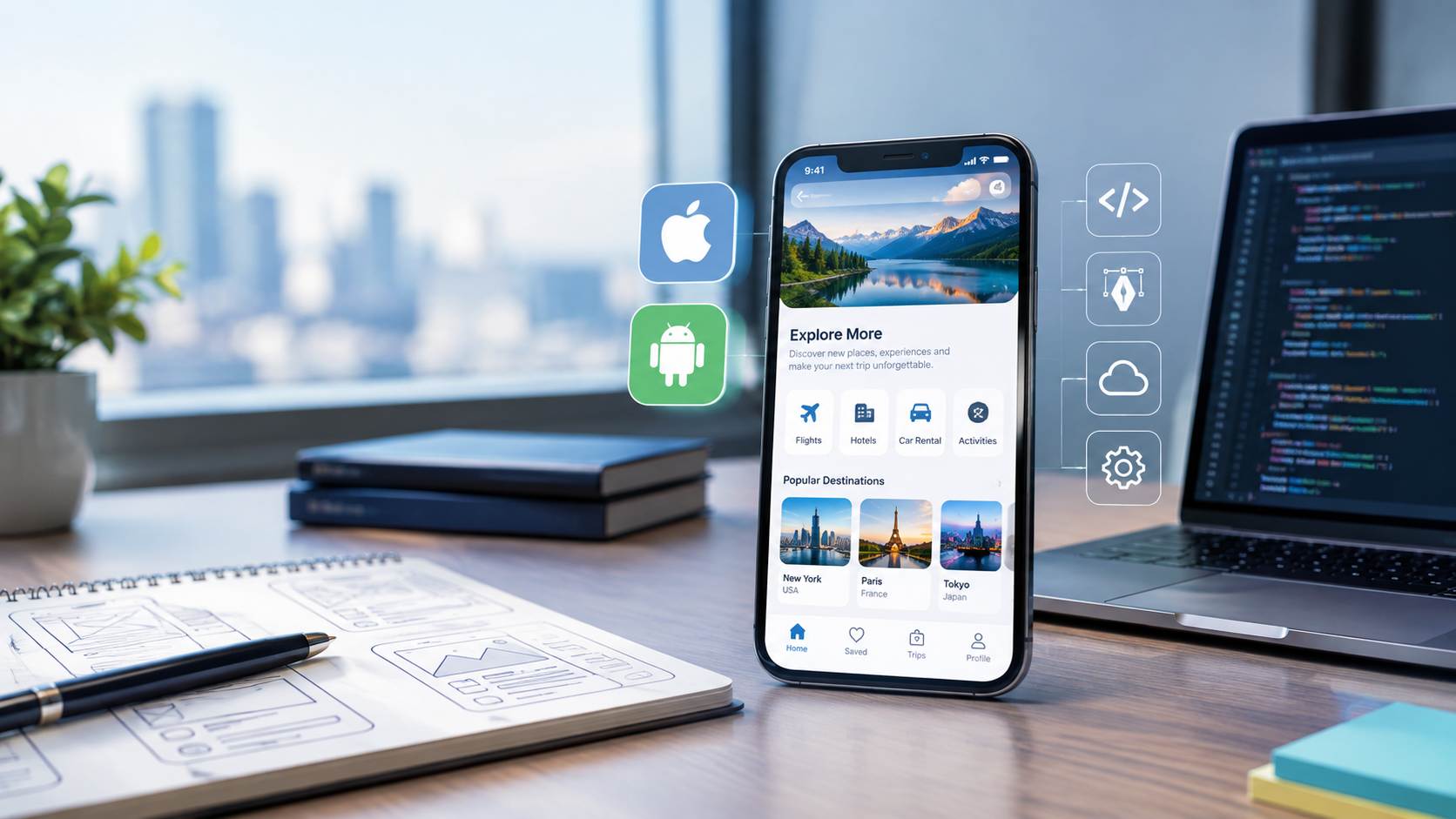
DualMedia says its mobile work covers both native and cross-platform development. Its published services include iPhone, iPad, Android, and web mobile development.
Possible project types include:
- Business and internal applications
- E-commerce applications
- Customer-facing mobile services
- Media and event applications
- Start MVPs.
- Applications connected to existing business systems
- Content and digital publishing platform
- Applications that require integration with external services.
The right architecture depends on what the app needs to accomplish. A simple content application has very different technical requirements than a real-time service, an e-commerce platform, or a business application.
Native vs. cross-platform development
One of the biggest decisions in mobile development is whether to build separately for iOS and Android or use a cross-platform approach.
Local development
Native development means creating an application specifically for a particular operating system.
For example, iOS applications can be developed using Apple’s technologies, while Android applications can utilize Google’s Android development ecosystem.
Local development makes sense when the application requires:
- Advanced device capabilities.
- Highly optimized performance
- Platform-specific functionality
- Complex graphics
- Deep integration with the operating system
Cross-platform development
Cross-platform development allows a team to build applications for multiple platforms using a common technology approach.
DualMedia lists technologies such asReact to local and fluttering.Of the ways it does this depends on the needs of a project.
For businesses, the benefit can be efficiency. Instead of maintaining completely separate development projects, a proper cross-platform strategy can reduce duplicate work.
However, cross-platform is not automatically better. The decision should be based on the application’s features, performance requirements, budget, maintenance requirements, and target devices.
How the DualMedia mobile development process works
A professional mobile application involves much more than writing code.
DualMedia describes a process that can include strategy and feasibility work, UX/UI design, development, testing, deployment, and post-launch support.
1. Project Discovery
The first step is to understand the business problem.
Before development begins, the team needs to know:
- Who will use the application?
- What problem does this solve?
- What platforms are needed?
- What features are necessary?
- Does it require an existing website or database?
- What integrations are needed?
- What is the expected launch timeline?
A clear project definition prevents costly changes later.
2. UX and UI Design
A mobile application must be easy to navigate before it can be visually impressive.
UX focuses on how users navigate through an application and complete tasks. UI focuses on the interface itself, including layout, controls, typography, and visual elements.
Good design can reduce friction and make it easier to find important tasks.
3. Development
Once the specifications and design are approved, developers build the application.
Depending on the project, the technical stack may include native iOS or Android development, cross-platform frameworks, APIs, databases, authentication systems, payment services, analytics, and other integrations.
DualMedia says it works with native iOS and Android technologies, as well as cross-platform approaches like React Native and Flutter.
4. Testing and Quality Assurance
Testing should take place throughout development rather than immediately before it begins.
A serious mobile project may require testing:
- Activity
- Performance
- Security
- Different screen sizes
- Different versions of the operating system
- Network conditions
- User flow
- App crashes and errors
DualMedia describes functional validation and quality testing as part of its mobile development process.
5. App Store Deployment
Finishing the code is not the same as starting the application.
The application may need to be developed and submitted to platforms such as Apple’s App Store and Google Play. DualMedia says that this store provides support for submission and publishing.
This process also includes preparing store information, screenshots, descriptions, privacy information, and other required content.
6. Post-launch maintenance
A mobile application rarely permanently crashes on launch day.
Operating systems change, devices change, security requirements evolve, and users request new features.
DualMedia says its post-launch services may include corrective and evolutionary maintenance, performance monitoring, ASO, operating system updates, new features, and analytics reporting.
How much does a DualMedia mobile application cost?
The application mobile dual media project does not have a single price.
The final cost depends heavily on the scope of the application.
A basic application with a small number of screens can be relatively straightforward. A complex platform that includes accounts, payments, real-time communication, advanced media, third-party APIs, administration tools, analytics, and multiple platforms requires significantly more development time.
DualMedia’s published materials also state that project estimates depend on factors such as application type, technical approach, and complexity.
Rather than focusing solely on the advertised starting price, businesses should cover a detailed proposal that includes:
- UX/UI Design
- Development
- Back-end infrastructure
- Third-party integration
- Testing
- App Store and Google Play submission
- Care
- Analytics
- Security
- Future feature development
A lower initial quote is not necessarily a better deal if important components are excluded.
What technologies can be used?
Technology should follow the plan, not the other way around.
Depending on the needs, a mobile project can use:
- Swift یا SwiftUIFor iOS development
- Kotlin or Android technologiesFor Android
- Express local reactions.For cross-platform development
- FlutterFor cross-platform applications
- APIs and backend services
- Cloud infrastructure
- Payment integrations
- System authentication
- Analytics platforms
DualMedia publicly lists native iOS and Android development, React Native, Flutter, PWA solutions, and backend/API integration among its technical capabilities.
The best choice depends on what the application needs to do.
What should businesses ask before hiring a mobile app agency?
Choosing an agency is a long-term decision. Businesses should look beyond a portfolio of attractive screenshots.
Ask these questions before signing the contract:
Who owns the source code?
Make sure the contract clearly defines intellectual property ownership and access to source code.
What happens after launch?
Ask what maintenance is included and what happens when Apple or Google release major operating system updates.
What features are included?
A proposal should clearly indicate what is included in the initial scope and what counts as additional work.
How will the project be evaluated?
Ask about real device testing, security testing, performance testing, and bug fixing procedures.
How will progress be reported?
Regular demonstrations and clear project milestones make it easy to identify problems before they become costly.
Is DualMedia suitable for US businesses?
Although DualMedia is based in Paris, an American company could test it as an international development partner.
The more important question is whether the agency’s capabilities match the project’s needs.
A US business should consider:
- Time zone differences
- Communication of action
- Terms of the contract
- Data protection requirements
- Payment arrangements
- Current support
- Intellectual property ownership
- App Store and Google Play requirements
- Integration with the current American business system
The decision shouldn’t be based solely on location. The technical experience of the development team and their ability to support the application over time are usually more important.
Application Mobile Dual Media vs. a General Multimedia App
The keyword can sometimes be interpreted differently.
AMultimedia mobile applicationAn experience can combine several types of content. For example, an educational app can combine video lessons, audio, written instructions, images, quizzes, and interactive elements.
This is a general product concept, not necessarily a reference to the company DualMedia.
If your search is specifically about the French agency, focus on DualMedia’s actual services and published capabilities rather than “DualMedia” being the name of a consumer app.
What makes a mobile app successful?
Technology is only one part of a successful application.
A technically impressive app can still fail if users don’t understand why they need it.
Strong applications usually start with a clear user problem and then simplify the solution.
Important factors include:
- A clear value proposition
- Fast loading and responsive interface
- Simple navigation
- Reliable performance
- Strong security
- Useful information
- Regular maintenance
- Good onboarding
- User feedback
- Analytics and continuous improvement
The goal shouldn’t be to add as many features as possible. The better approach is to develop features that users actually need and that work well for them.
Final thoughts
Application Mobile Dual MediaTypically refers to DualMedia’s custom mobile application development services rather than a single app that users download from the app store. The agency works on iOS, Android, cross-platform development, UX/UI, deployment, and ongoing mobile support.
For businesses considering an app, the most important step before choosing a technology is defining the project. A clear scope, realistic budget, strong UX, proper testing, and a post-launch maintenance plan can make a much bigger difference than simply choosing the latest development framework.
Frequently Asked Questions
Is the application a mobile dual media downloadable app?
Not necessarily. The term primarily refers to DualMedia’s mobile application development services. DualMedia is a digital agency that builds custom mobile solutions rather than just offering a consumer app.
Does Dual Media develop iPhone and Android apps?
Yes DualMedia says it provides mobile application development for iPhone, iPad and Android, including native and cross-platform approaches.
Does DualMedia use React Native or Flutter?
Yes, DualMedia lists React Native and Flutter among its cross-platform development technologies. The appropriate choice depends on the project’s needs.
How much does the DualMedia mobile app cost?
There is no universal price. Costs depend on application features, design requirements, platforms, integrations, back-end infrastructure, testing, and ongoing support. A project-specific quote is required for an accurate estimate.
